Wake up!
Wake up! You pick up your phone for a quick check—and hours vanish. The average person unlocks their phone 60+ times a day. Since the iPhone dropped, suicide rates climbed 30% overall—and 62% among youth.1 Each extra hour of screen time raises suicidal thoughts by about 10%.2 And last year? 332 recorded school shootings (K-12).3 Tf? Not random. Not isolated. Systemic. The truth: iPhones trap attention at all costs.4
Addictive design doesn’t just waste time—it kills connection. People. Relationships. Purpose. Nearly 1 in 2 of us have lost someone to suicide. 1 in 5, two or more. That’s not coincidence. That’s negligence.5
If phones cause disconnect by design, then the answer is presence by design. Face-to-face lowers stress. It builds empathy. A jiu-jitsu roll. A yoga flow. A massage.
Coffee after mass. A pickup game. These aren’t extras—they’re essentials for being human. The problem isn’t that we don’t care. It’s the gap—between scrolling and showing up.
OPENMAT closes that gap. One link. You tap. Save your wallet pass—right next to your boarding pass and credit card—and show up in person. No app. No feed. No download.
Pay directly with your mobile wallet—faster and safer than cash. From your phone through the door—back to reality. We build and measure three results:
• Presence: did you show up? % conversion?
• Practice: did you return? Avg. $ spend?
• Invitation: network coefficient? avg. group size?
It works like a window shop. Your one link shows your offers. Each offer includes claims and redemptions—so you literally see the real line/crowd form from your phone.
Redemption is possible via your mobile wallet’s NFC capabilities. It feels like a handshake. Each redemption mints you one Real Person Coin (RPC)—proof of presence. Proof you’re no NPC.
Customer
If your superpower is presence. Yoga teachers. Jiu-jitsu coaches. Massage therapists. They hold space for breath, sweat, and belonging. But the systems they depend on pull them away from what they do best—presence. Discovery happens on Instagram. Scheduling in DMs. Pricing in PDFs. Payments through Venmo, after-the-fact.
Tools are fragmented. Time is fractured. It’s a system designed for sitting where you are. Not showing up. Yukito built a family on his Studio86 mats—yet 70% of new students quit within a year.6 With 100 members at $150/month, he could gross $180K, but churn erases $126K.7 He tapes flyers to lampposts, tracks attendance in spreadsheets, and chases payment over text.
Severin and Maja’s Stark Jiu Jitsu studio hums every Friday night, but you’d never know unless you stumbled in. Pricing is scattered: $150/month, $800 for six, $1,200 for the year. Their WhatsApp group has 110 members, but half never pay—$90K gone, every year.8
Angelika has 30 years of healing in her hands. Her clients leave lighter, grounded. But 15–25% don’t show up. That’s $12K–$20K lost each year—gone without warning.9 Sacni teaches across multiple studios—vinyasa here, bikram there—relying on studio MindBody accounts for group classes and DMs for privates. With 3,000 Instagram followers, she should book nine $300 sessions a month. Instead, she books two—losing $25K a year.10 Thérèse offers healing touch at her church—free. Her gift transforms people. But without a way to announce sessions or even accept donations, her presence stays invisible.
Every practitioner hits the same three walls:
• Broken Systems: discovery, scheduling, and payment are scattered.
• Outdated Tools: 91% of Gen Z use mobile wallets; most practitioners still rely on
paper, PDFs, or cash.
• Manual Everything: no reminders, no subscriptions, no referrals. All ad hoc.
The result: a practice that can’t sustain the practitioner. Students feel it too. Google Maps points to buildings, not people. Reviews praise the gym, not the teacher. Instagram captures attention but doesn’t get you in the room. No system ties identity to presence.
And this isn’t just fitness. The same pattern repeats anywhere people gather: Charlie, a streetwear designer, runs local pop-ups but can’t turn Story views into foot traffic.11
Johannes, a farmer, brings raw milk to market but can’t forecast demand. +95% of independent small business operators (~28M in the U.S.) still rely on cash, paper flyers, and punch cards. They can’t code. They can’t afford engineers. They can’t navigate API hell.12
Close networks like Studio86 and Stark pulse quietly—an Instagram tag here, a story mentioned there—but their true value is invisible. Over half of U.S. adults have just 1–4 close friends; 8% have none. Anthropologist Robin Dunbar’s research suggests we need ~15 trusted relationships to feel supported.13 No algorithm can fabricate that. And online friends don’t count.
“Church” isn’t just pews anymore. It’s Sunday open mat. Wednesday candlelit yoga. Friday massage circles. But when the session ends, the moment dies. Follow up later via
email, and only 10–20% respond. Ask in the room, and 70% engage.14 Belonging isn’t built online—it’s earned face-to-face. Yoga and jiu-jitsu were never meant to be workouts. In India, yoga means “to yoke” your relationship with God—it’s a lifestyle, not poses on a mat. Jiu-jitsu, “the gentle art,” reinforces presence and brotherhood, not trophies from a comp. These are spiritual practices because we’re spiritual beings. But today they’ve been stripped to sport, packaged as fitness, and sold as content. Instructors scrape by on $1,500–$3,000 a month, while the real engine—1:1 transmission—is lost. Though 50–70% offer privates, fewer than 30% book them consistently. Gurus don’t teach classes. If anything, privates should sustain them, but without 1:1 infrastructure, lineage dilutes and soul disappears.15
Many start for fitness. Those who stay—the ones who show up week after week—become disciples. They carry lineage. They build culture. Yet they go unrecognized. No rewards. No referrals. No record of their devotion. Their legacy lives in Instagram bios. Their loyalty dies in comment threads.
Participation is faceless today:
• Anonymous Reviews: feedback links to places, not people.
• Mentor Gap: no 1:1 infrastructure nor network model.
• No Reward: discipleship feels fruitless.
In-person networks are bulbs without sockets. Participants are the filament—they light up by showing up. But they need three things:
• One link. Works everywhere—Maps, Instagram, text, email.
• One tap. Claim in seconds. Reminders from your wallet until you show up.
• One identity. You came or you didn’t. Nothing else matters.
OPENMAT is the socket and the switch—from phone to door, making real presence visible, rewarded, repeatable.
Model
A six-step closed loop—a perpetual engine that turns scrolling into showing up. Not a funnel, a flywheel. A story view into someone at your door. A drop-in into a membership. Proof you showed up. You’re for real. You belong.
The left side is Supply—connect payment and share your link. The right side is Demand—claim, redeem, amplify. Our goals: (1) minimize # steps (taps) from phone to door, (2) maximize # redemptions. As simple and effective as possible.
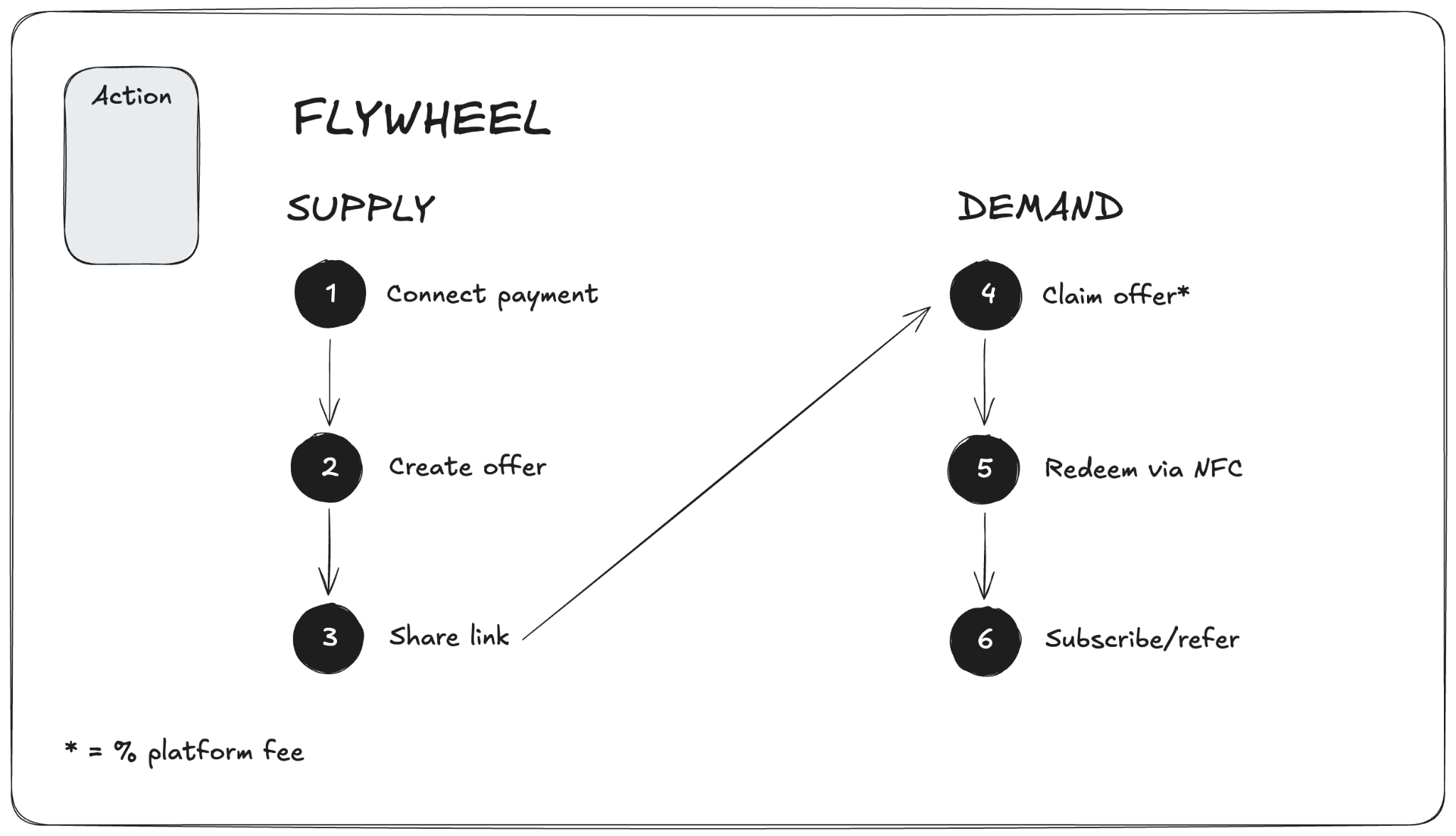
Customers tap it, claim a pass, save it to their phone wallet, and redeem it in person. The system follows up to prompt coming back and inviting others. Never more than three taps from sharing to showing up.
Supply 1. Connect your payment. OPENMAT auto-generates a branded, mobile-first deep link—pre-integrated with Apple Pay, PayPal, Stripe, etc. No code. No setup. 2. Create your offers: a class, a donation, a service, a pickup, a pop-up. Be creative.
Customize with pricing, group rates, limited-time deals, loyalty discounts. Tools that increase your value, drive urgency and result in more people showing up.
3. Share your one link where your people already are. Instagram drives discovery (61% of users find services there).16 Google Business signals intent (1,803 average monthly views; 5% act).17 SMS delivers immediacy (98% open rate; 28% click-through).18 WhatsApp, email, DMs—every channel has its strength. OPENMAT doesn’t compete with these tools—it completes them.
OPENMAT’s isn’t about bells and whistles—it’s about clarity. Connect payment once. Get one link. Drop it where people already find you. And more people actually show up.
Remember the analogy of the window–real world services/transactions already exist: OPENMAT (1) makes it effortless screen-to-door, (2) spotlights them. No cost. No app.
No risk. No brainer. Adoption spreads itself. Everything else—referrals, subscriptions, group invites—is compounding upside. Every extra screen increases drop-off by 10%.19 That’s why OPENMAT design has one rule: no flow is ever 3 taps away from claiming, redeeming or sharing an offer. We’re building for low-friction, high-frequency loops—for scale. Inspired by viral patterns like Snapchat and retrofitted for your mobile wallet, OPENMAT slides next to your credit card—not another app, but snug in your wallet. Anyone can create and share a link.
Anyone can claim and redeem. And no “business” onboarding. Instagram proved people are the brand—OPENMAT proves you don’t need a storefront for people to show up.
Demand Once the link is live, the demand loop begins: 4. Claim your pass and save it to your Apple/Google Wallet—pre-installed on nearly all phones. From there, OPENMAT handles reminders, updates, and confirmations—delivered through the wallet, not competing within inboxes. Data shows these auto-reminders can cut no-shows by up to 75%.20 5. Redeem via your mobile wallet’s NFC. 10X faster than cash/manual check-in!21 Redemption is more than a transaction—it’s proof you showed up. Proof you belong. Social media rewards scrolling. OPENMAT rewards showing up.
6. Return again thanks to personalized prompts—subscriptions, discounts, invites for friends. Timing is everything: over 80% of satisfied clients say they’d refer
someone if asked at the right moment. That moment is right after the in-person experience.22 Platforms like Pinduoduo have shown how time-sensitive, shareable offers can spark viral transactions through WhatsApp group chats. We adapt that growth mechanism for providers, customers, and their real-world communities.
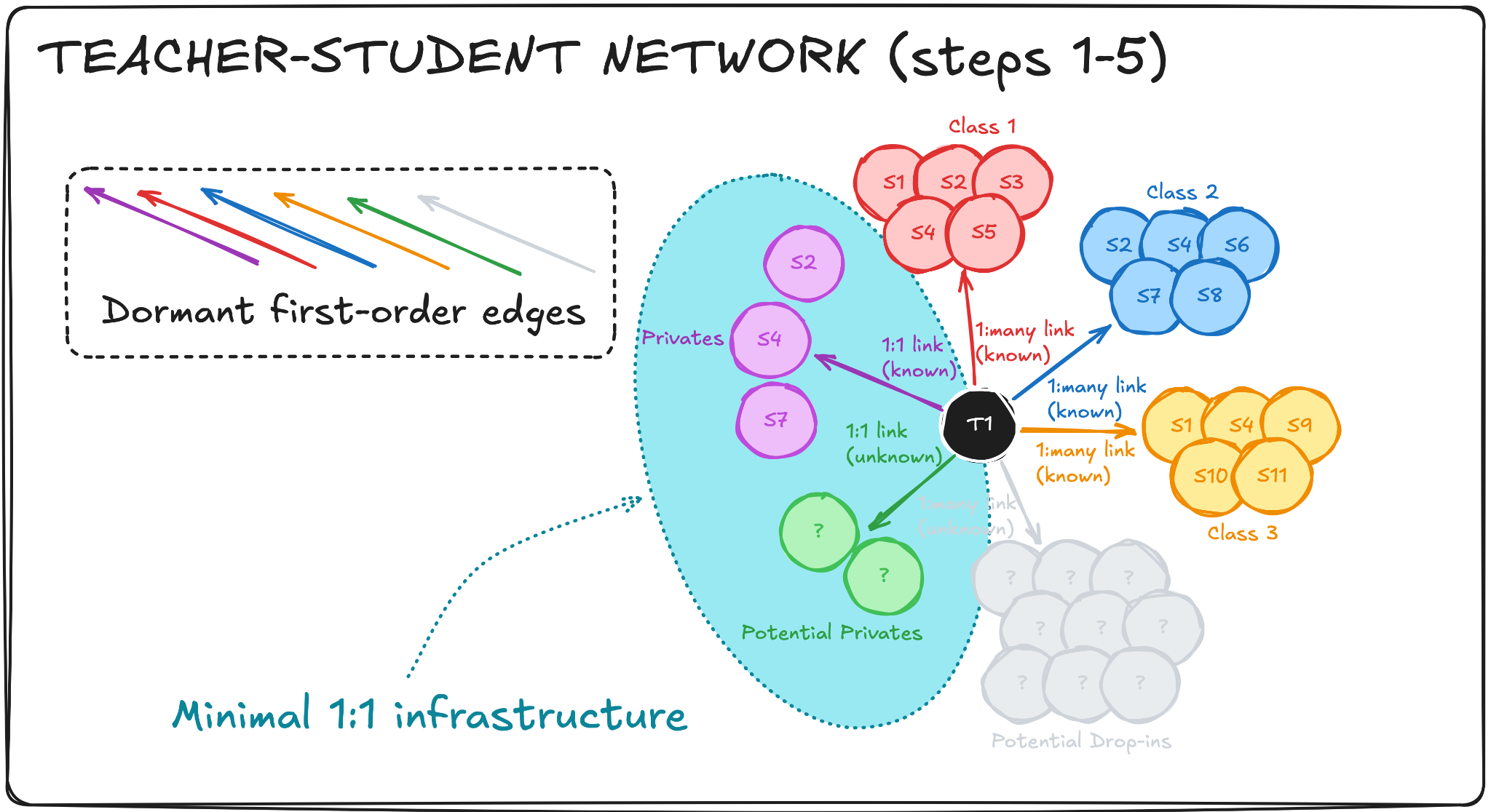
This creates first-order distribution and builds network effects as the link spreads. No platform today gives local providers this kind of loop: built-in tools to trigger referrals and drive payment—donation, subscription, it’s all the same so long as people show up.
And the need is massive. Over 90% of people trust referrals from friends—yet fewer than 10% of grassroots superheroes have a way to activate that trust at scale.23 OPENMAT links and offers track views, claims, and redemptions. Social proof for presence itself.
With nothing more than a wallet pass and default notifications, redemption rates can exceed 80%—order-of-magnitudes from the 10% norm in traditional booking flows.
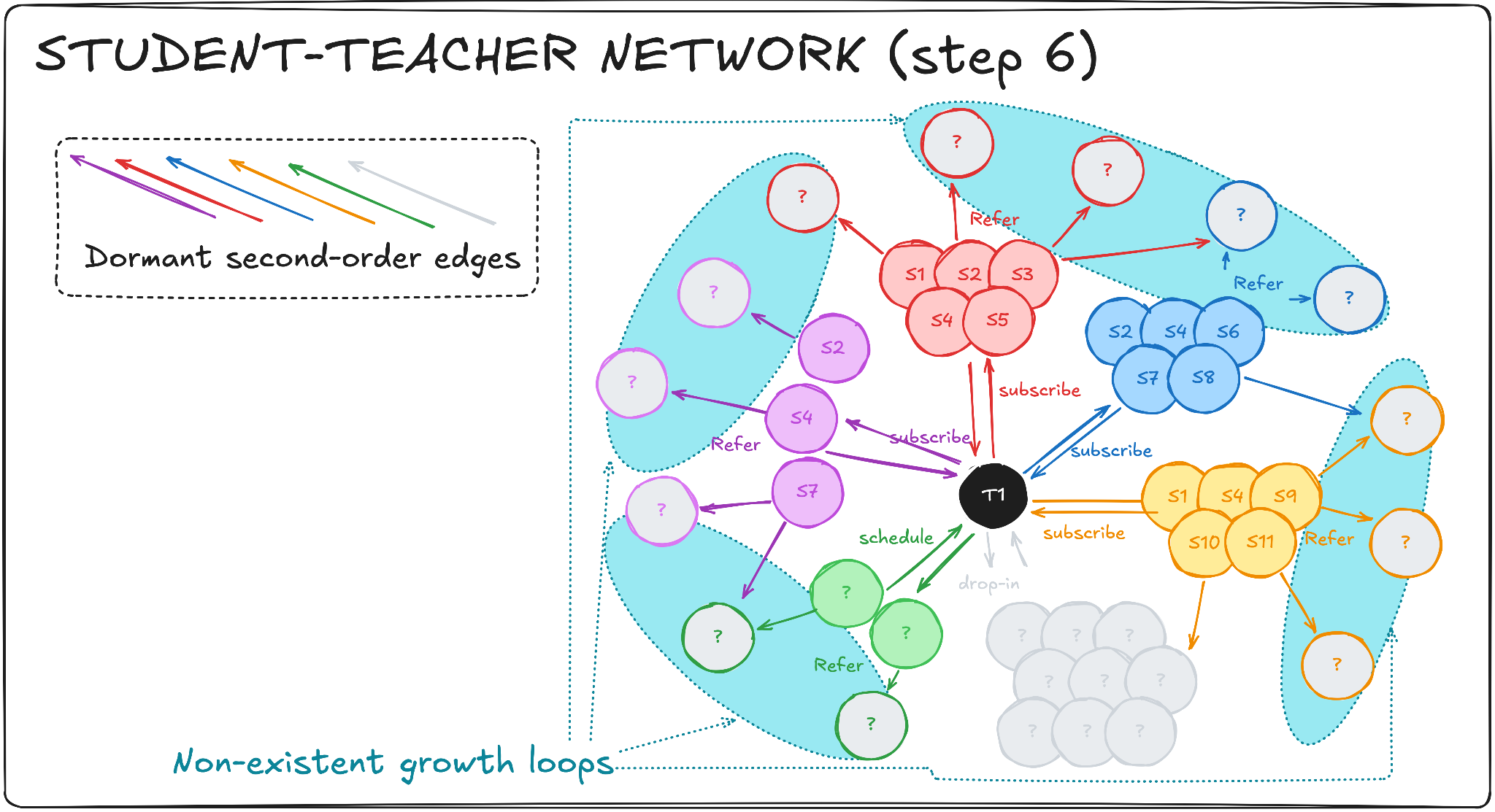
One yoga teacher uploads her offers/schedule and shares her link—via Instagram Stories, Google Business, even personal text for select clients. Within hours, her 50–100 students are online. And because every offer is designed to be claimed, redeemed and shared, her reach can easily expand beyond her existing circle. Even 10,000 instructors implies an active potential of 500,000-1,000,000 customers.
Our real multiplier isn’t tech—it’s mimicry. People copy what works. They follow peers, trade tools, and share experiences. Some influence dozens. Others activate thousands.
One thought leader genuinely using OPENMAT is worth more than any ad campaign. Partnerships with keystone figures—those with reach, trust, and visible proof—are gasoline on our go-to-market.
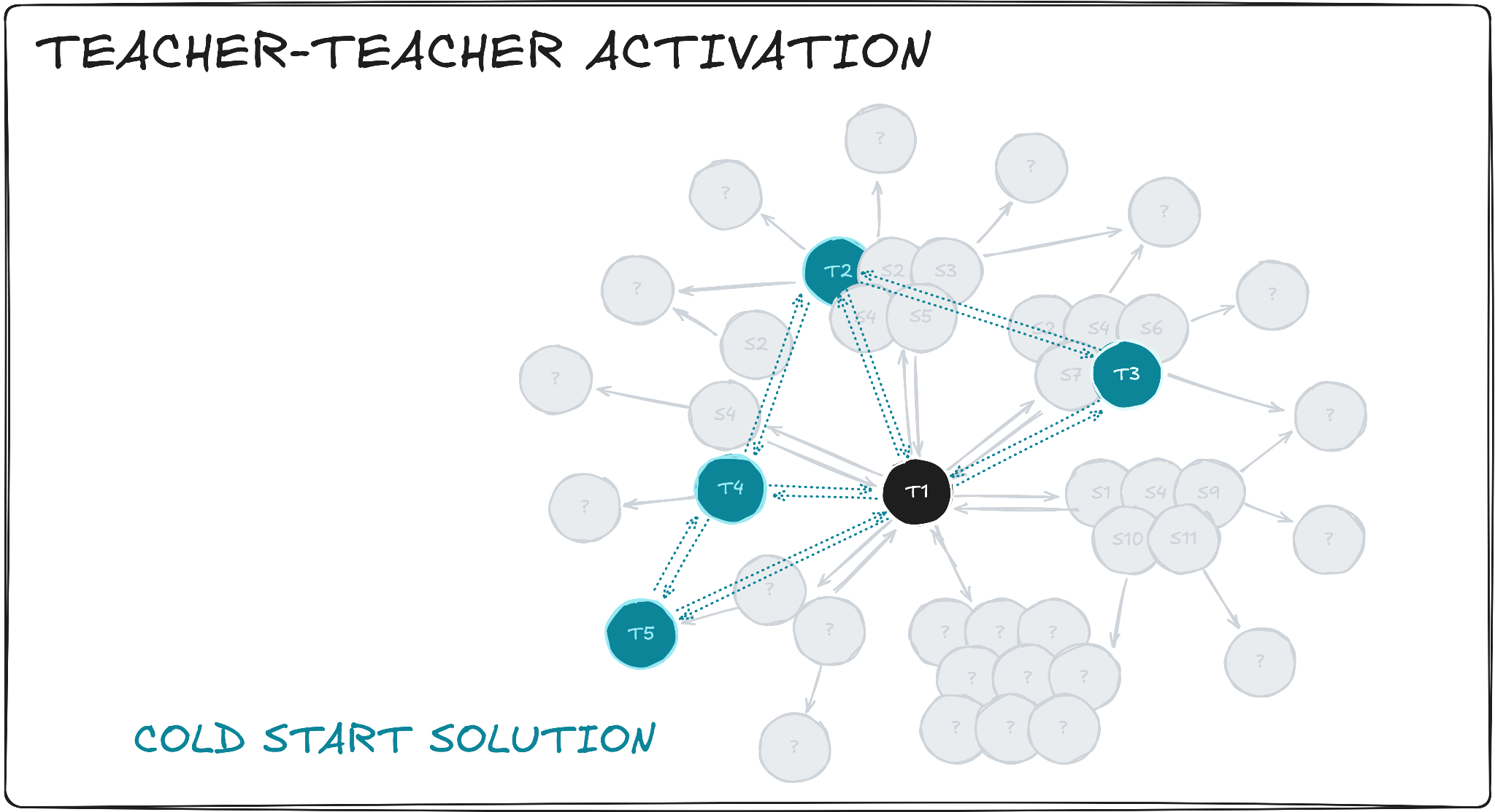
Each connection carries different weight depending on reach, credibility, and influence in their community. This peer-to-peer loop is a cold-start accelerator—turning individual presence into network momentum.
Shared-incentive models prove the point. OnlyFans paid users for referrals, and creators became recruiters. A similar structure—where referral rewards tie directly to real-world earnings—aligns incentives, fuels organic growth, and turns participation into propagation.
Design
Success is by design. The smallest of early frictions kills long-term adoptions. OPENMAT must be a no-brainer—no downside, no effort—because actually showing up is real work.
1. We never ask before we give. Providers link payment once. Customers add identity only for clear upside—discounts, rewards, status. 2. No flow exceeds three taps. From seeing an offer to claiming, redeeming or sharing—each accomplished in seconds.
3. No difference between people and businesses. Everybody has one link. And it works everywhere—Instagram bio, Google Maps, SMS, DMs. 4. For your wallet. Next to your boarding passes and credit cards. Reminders from there. Payment wallet to wallet.
5. Spotlight > Schedule. We’re not creating calendar events. We shine light on what’s already happening in the real world. 6. Redemption is our atomic unit. One tap, in person. Every feature optimizes toward more redemptions, faster redemptions, easier redemptions.
7. Distribution starts at zero friction. Every incremental level of complexity decreases the value we can deliver. 8. Zero Downloads. Nobody installs an app or creates an account to start. Link → claim → wallet → redeem.
9. Killer Clean. All infrastructure—payments, encryption, notifications—is hidden. OPENMAT feels lighter than cash, safer than cards, and simpler than apps. 10.People copy people. When one link fills a room, others notice and adopt it. Each design choice should increase usefulness or amplify mimicry.
Success is not accidental. Not random. Success is by design.
Metrics
We build for Redemption. The word means to get back what’s been lost—to restore value through action. That’s exactly why OPENMAT exists: to move people from scrolling to showing up. We can code every feature and write books of words, but none of it matters unless they get you through the door. From there, two questions remain: (1) did you return, and (2) did you bring your friends?
The market model scales on paper. But the engine—the system under the hood—has to hum like a Ferrari. Deep links generate automatically. Friend-of-friend mapping runs silently in the background—no lag, no friction. Wallet notifications land every time.
Wallet-to-wallet payments move instantly. And network effects compound so that every provider, every session, every share spins the flywheel faster. We measure backwards from Redemption. It’s step five in the flywheel—the proof that everything before it worked. Providers onboard. Offers go live. Links circulate. Channels perform. Views, taps, claims—all logged but secondary. None of it matters until another person shows up. Attribution across Instagram, Google, and SMS reveals what truly drives real-world action. Because when redemption happens, intent becomes fact, payment clears, the loop closes—and spins again.
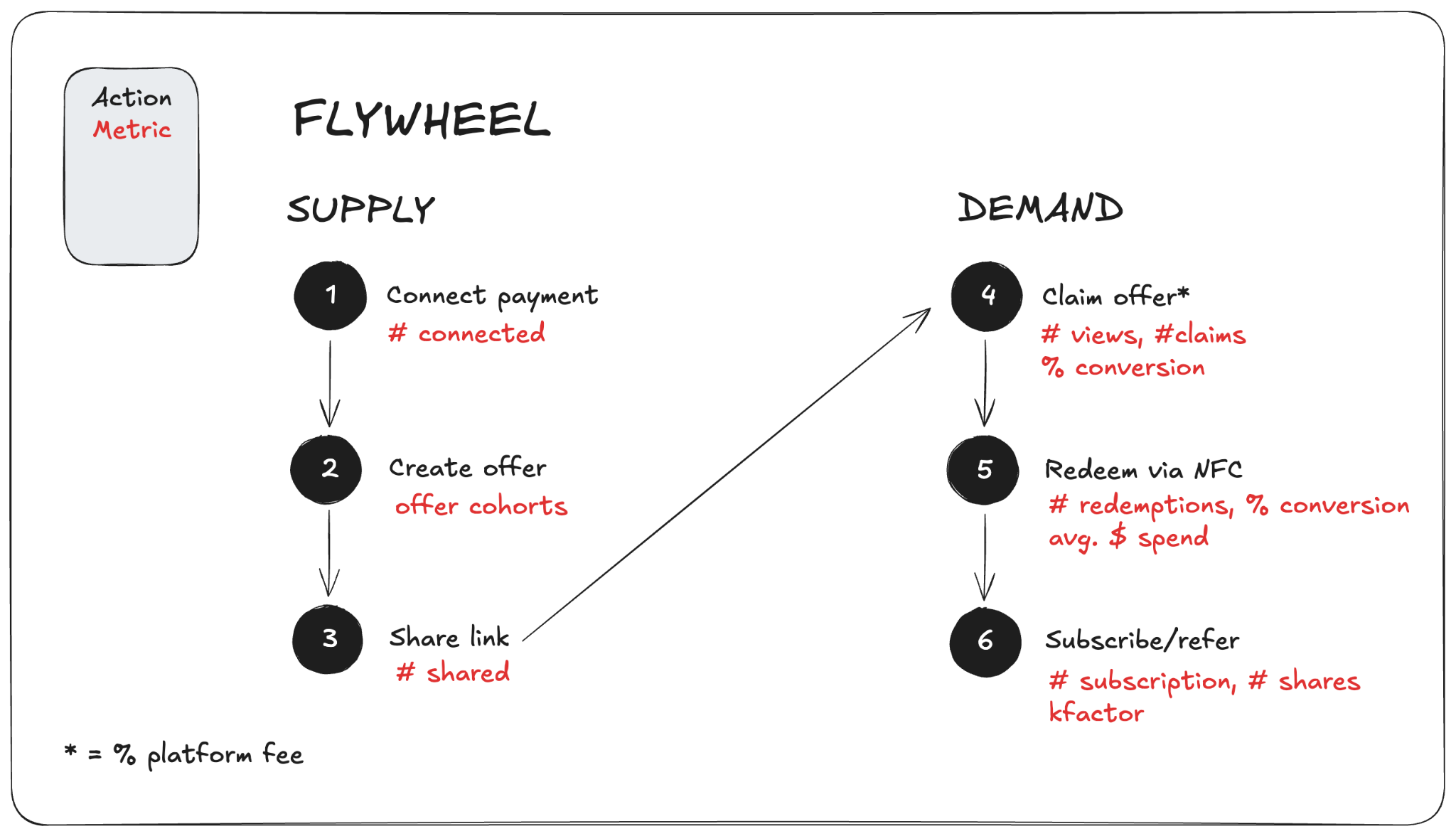
These numbers show exactly where the loop is working and where it needs improvement. Once you show up, the real game begins. Tiered subscriptions and pass-it-on deals make it more likely you’ll return—and bring friends. Metrics like return frequency and cohort analysis (who comes once, twice, three times) help providers see and serve their disciples. In rhythm with natural cycles: gentle nudges when it’s been a while, timely offers when you’re nearby. Creativity turns this feedback loop into an art form.
While redemptions and returns show the health of individual providers, invitation-centric metrics—k-factor (how many new users each participant brings) and average group size per redemption (how often people attend together)—reveal network health. Referral prompts trigger upon claim and redemption. Group purchase makes inviting others a single tap. When a provider’s k-factor climbs above 1.0, growth becomes self-propelling:
rooms fill, reach expands, and momentum builds—without a cent spent on ads. The cost of advertising must be zero. That’s our point. OPENMAT is the signal that you actually showed up—more valuable than anything you can post or say. When the loop works, product spreads by doing what it was built to do: make in-person participation effortless to find, share, and return to. Even if only a fraction of 10,000 providers build small but active networks, the system scales naturally to hundreds of thousands of users—no sales team required.
Tech
Designed to put down and show up. Not look at more. Each technical layer for one purpose: actually showing up. It starts with (1) connecting payment. A provider links Stripe, PayPal, or Apple/Google Pay once. No code. No integrations. From that moment, OPENMAT can generate live, branded links automatically.
Next comes (2) creating offers. A private session, a class, a farm pickup, a donation, a pop-up—anything can be listed. It can be free, require a deposit, or be paid in full.
Complete freedom to customize. Offers can carry parameters like expiration dates, group rates, or quantity limits—tools that surface value, create urgency, and spark sharing.
Then comes (3) sharing the link. Every provider, every offer, every event has one canonical link—instantly shareable across Instagram, Google Maps, SMS, WhatsApp, or email. OPENMAT doesn’t replace these channels; it completes them.
When someone taps the link, an embedded web app or App Clip opens. Two fields: name and photo. That’s it. Seconds to onboard. No downloads. No login walls. These links are the arteries of the system—flowing from providers to customers and out into their networks.
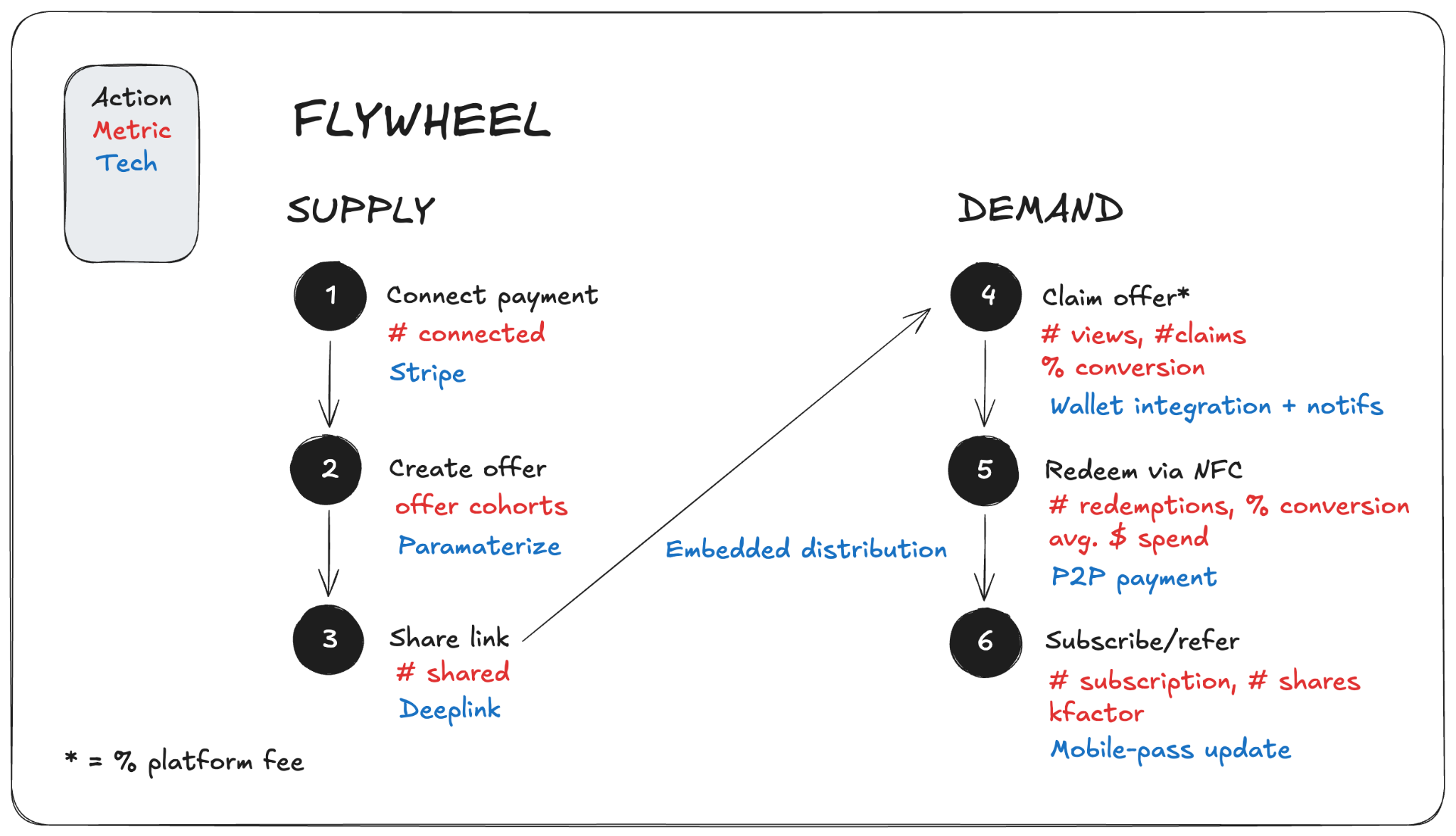
Once an offer is claimed, (4) wallet integration kicks in. Today, saving a pass means wrangling APIs like PassKit—too technical for most. OPENMAT removes all of that. Tap the link, claim the offer, and the pass drops straight into your phone’s wallet. No code. No confusion. Notifications ride the lock screen by default—where attention is inevitable.
Native tooling delivers one outcome: show up. Then comes (5) redemption. In-person check-in or payment via NFC or QR—aligned with how people already behave. Most phones and POS systems already support tap-to-pay, and 91% of Gen Z prefers it. With OPENMAT, it’s seamless: tap your phone, pay or check in, and step inside.
Every offer becomes a real-time feed. Every view, claim, tap, and redemption is logged—not just for analytics, but as proof that people cared enough to pay and show up. Proof that it’s worth (6) sharing with friends. This is the bridge from online signal to offline presence. Urgency, visibility, and momentum pull people off screens and into reality. Presence becomes proof—and proof drives growth.
OPENMAT is POS-agnostic and future-proof. It works with Stripe, PayPal, and any modern processor—no migrations, no proprietary hardware. Data is end-to-end
encrypted, SOC 2 compliant, and privacy-first by design. Web-native architecture means updates roll out instantly—no app store lag, no user confusion. In plain terms: connect payment once, share a link, and everything just works—claim, wallet, redemption, referral. A loop so light it isn’t even an app on your phone. And yet so effective it lives in your mobile wallet, right next to your Visa card and boarding passes.
TAM
Does the loop work? “How big can this be?” is a consequence, not a starting point. Market size follows behavior. If showing up becomes easier, more reliable, and naturally spreads, growth is inevitable. If people don’t show up, nothing else matters.
OPENMAT rests on two structural truths: (1) Usefulness: do more people show up? And (2) Uniqueness: is the loop simpler, tighter, and more trusted than alternatives? If both are true, TAM is not a ceiling—it’s a function distribution. If either is false, there is no market.
The baseline already exists. In the U.S. alone: ~300,000 yoga instructors,24 100,000 martial arts coaches,25 and 150,000 licensed massage therapists.26 Each serves 50–100 clients monthly—over 50M+ in-person sessions each month. Practice is everywhere. Infrastructure is nowhere.
OPENMAT doesn’t invent behavior—it removes the last inch of friction. Capture just 1% of that existing flow: 500,000 monthly redemptions, $10M in tracked payments (at $20 per session). That’s before repeats, referrals, subscriptions, or international adoption. Once one provider experiences unique value, others follow. Growth spreads through proof, not promotion.
Growth OPENMAT grows through product-led behavior in four self-reinforcing loops: α—early adopters: trusted peers use it, others follow. β—later adopters: customers experience the loop, then apply it themselves. γ—subscribe: guests become regulars. δ—refer:
customers bring friends.
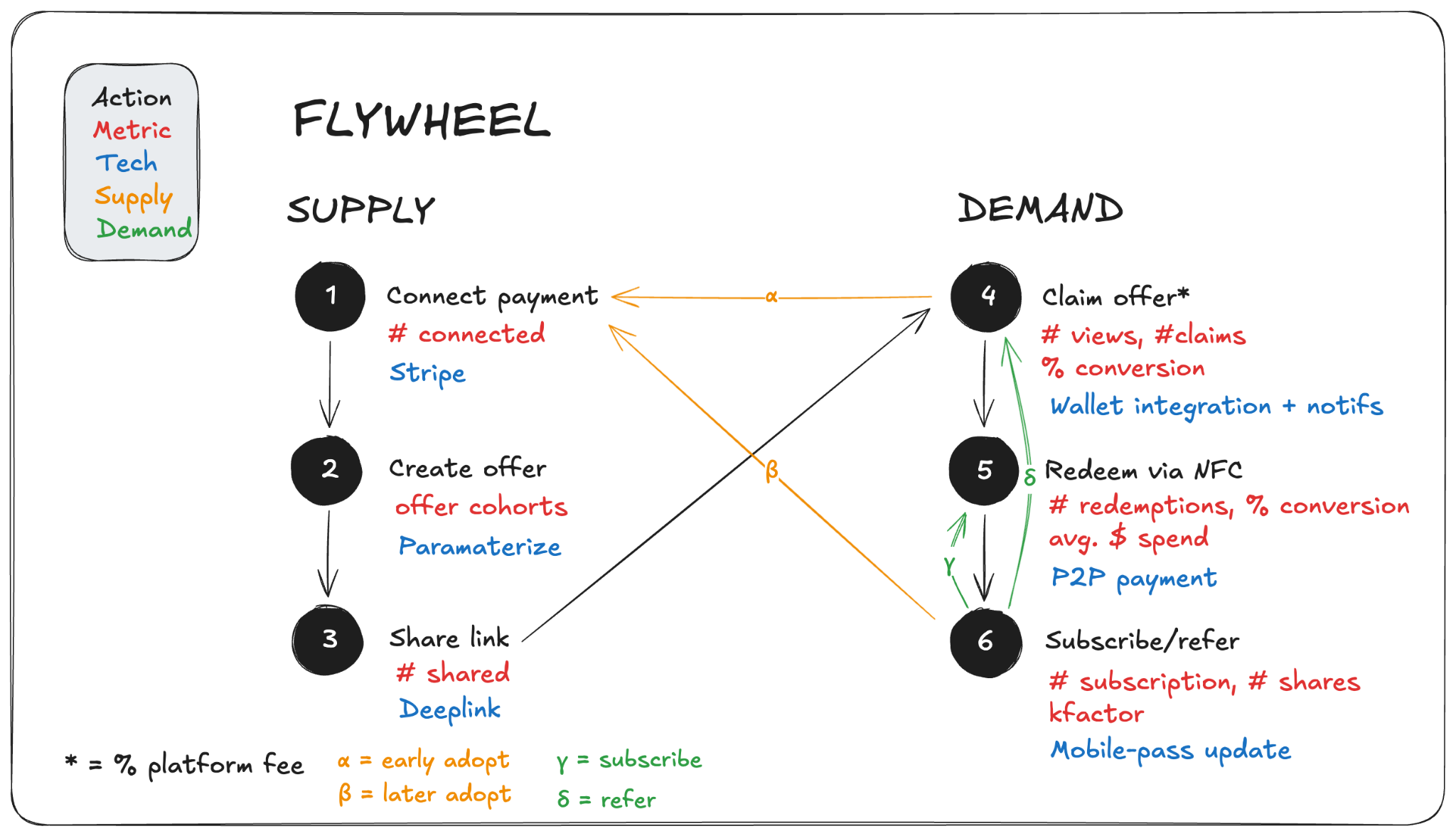
The result: logarithmic growth. The effect is a chain reaction: you share an offer → someone attends → they return and invite others → peers notice and adopt the loop. The goal isn’t virality—it’s network density. Is the room buzzing? Is the circle growing tighter?
Network density = actual mutual connections ÷ maximum possible connections. For a group of N members, the maximum is N·(N−1)/2. With 20 members, there are 190 possible connections; if 95 exist, density = 0.5. Higher density means more trust and faster adoption. Product design must increase density—by connecting people geographically close, bridging isolated groups, sparking first-time interactions, and rewarding shared practice.
Seed growth begins with a single provider. If they experience unique value, others emulate. Targeting epicenters accelerates this—Mysore for yoga, Austin or Rio for jiu-jitsu. Trust built in hubs creates spillover: practitioners adopt OPENMAT abroad, then bring it home. But this only works if OPENMAT itself carries credibility. Without it, elites don’t adopt—and the dominoes never fall.
Verticalization OPENMAT isn’t limited to yoga, jiu-jitsu, or massage. If usefulness and uniqueness hold, expansion is inevitable: one link, one tap, one identity. Start with two or three adjacent
verticals, focus on their epicenters, and let behavior—sharing, attending, repeating—drive growth. And payment matters. Even priests depend on donations. Offers can be free or optional, but payment is a proxy for devotion. Whether you’re a musician, farmer, barber, or protester—anyone who needs people to show up—OPENMAT is designed to make participation effortless. No other system today proves presence. Partnerships can accelerate adoption, but they aren’t required. If the loop works, growth is organic.
Some use cases, like religious gatherings and protests, hold massive potential. But chasing them too early is a mistake. First, perfect the loop. Then, it scales itself.
Footnotes
- CDC, 2024.
- CDC, 2025.
- WHO, 2023.
- Center for Homeland & Security 2025.
- WHO, 2023.
- IBJJF Statistics Report, 2023.
- 100 members x $150/month x 12 months x 70% churn = $126,000 lost.
- ((80 members x $150/month x 12 months) + (20 members x $800/month x 2 per year) + (10 members x $1,200/month x 1 per year)) x 50% = ($144K + 32K + 12K) x 50% = $188K x 50% = $94K lost.
- Massage Therapy Journal, 2024.
- 7 * $300 * 12 = $25,200 lost.
- Forbes, 2023.
- Census, 2024.
- Pew Research Center, 2023.
- Search Engine Land, 2016.
- Brett Larkin, 2025.
- Facebook Business.
- BrightLocal’s Google Business Profile Insights, 2023.
- Mobile Marketing Watch, 2022.
- Nikita Bier, Twitter.
- Mindbody.
- Eventbrite, Improving Event Entry with Contactless Check-In, 2022.
- Exploding Topics.
- Nielsen, 2022.
- Yoga Alliance, 2021.
- IBISWorld Industry Report 61162, Martial Arts Schools in the US, 2023.
- AMTA, Massage Therapy Profession Overview, 2023.