Digging to the Roots of Yoga
While yoga is an individual practice, traditionally taught one-to-one from guru to student, most people in the West experience it in a class. I wanted to understand why, so I enrolled at the Bihar School of Yoga in Bihar, India. It was supposed to be super special. My OpenMat 1.0 cofounder was deeply influenced by "A Systematic Course in the Ancient Tantric Techniques of Yoga and Kriya," and that author founded Bihar School. A close mentor's mom, whose apartment in Switzerland I was living in at the time, considered Bihar School to be her spiritual home and that Swami her guru. And when I told ChatGPT I was after the "roots of yoga," it told me to go there. Three perspectives I trust, all pointing to one place. So I applied, got accepted, and went for the month of June.
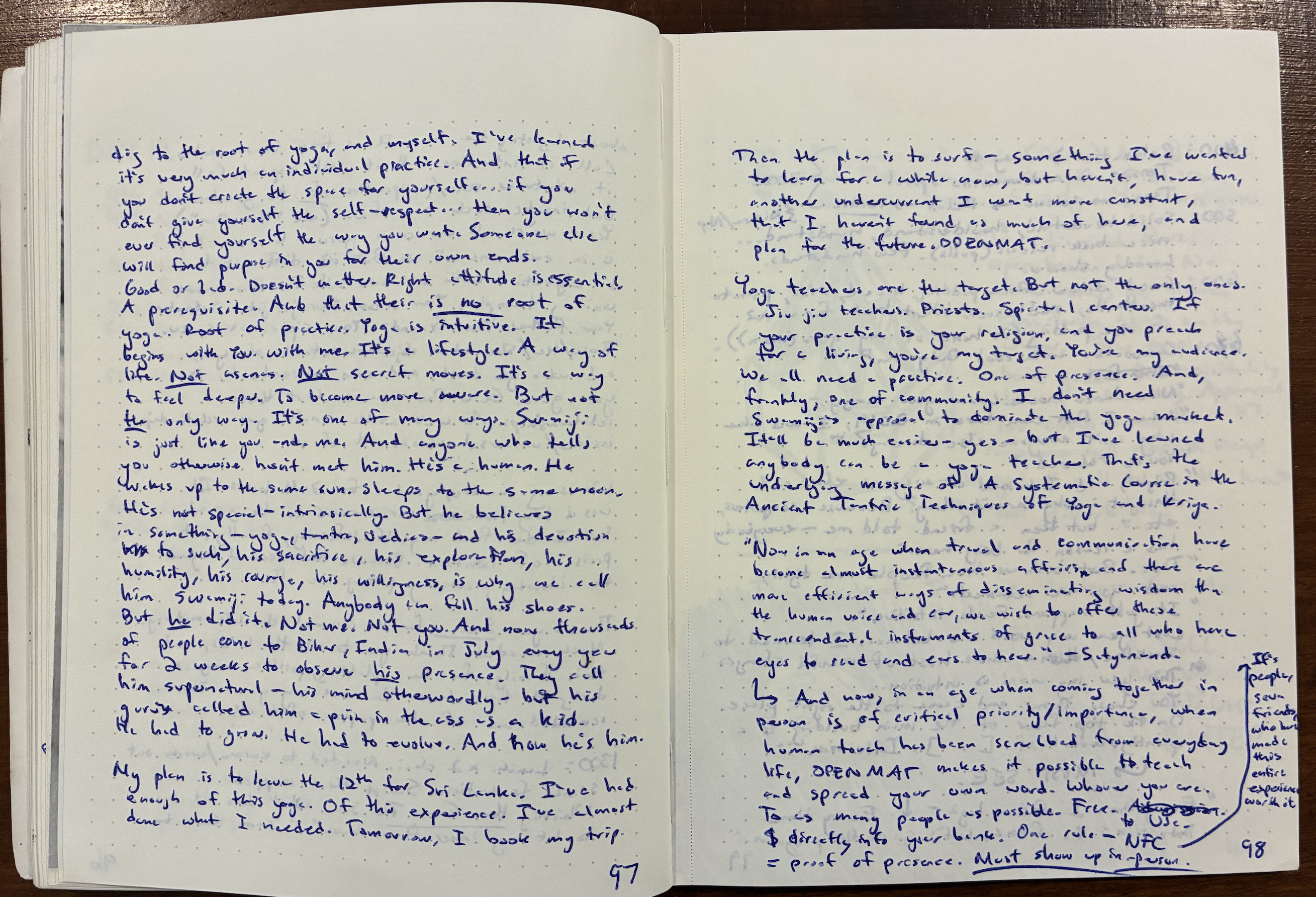
My goal was to dig to the roots of yoga. What I found is that the root is not in any one place. The root is you--if you're willing to follow it.
Yoga is intuitive. At times, I think way too much. So I enjoy things that quiet all the noise and help me feel my body again. Then I notice tension--say in my lower spine--and it feels right to, say, touch my toes and feel into that tension. I broke my right collarbone at 12. Years later, through practice, I felt that exact place unwind through extended shoulder stands. As one spot releases, another appears to follow. Over time, you arrive at the same shapes you'd find in a 90-minute bikram class--but the difference is that you arrive there yourself. You're not being told where to go. You're listening.
That's the break: the belief that you need someone else to show you the way instead of trusting what you feel.
Yoga means to yoke--to wake up your mind and body in preparation for meditation or prayer. When you lean into a tight place, the release isn't just physical. It's tied to what's held there. Experience and memory are stored not just in the mind, but in the body. So when something releases physically, something must necessarily release mentally, too. You see it in movement. The most capable people aren't the biggest-- they're the loosest, the most free. Bodies move the way minds do.
That release stays with you. What was holding you becomes conscious again. This is meditation, prayer. But to receive anything clearly, you have to tune the receiver that is your mind and body first.
I've experienced this outside of traditional yoga most significantly. I broke my left wrist and elbow growing up and believed I was right-hand dominant. That belief sat in my body. Then I started playing tennis with my left hand because it seemed advantageous to be able to do so. My left wrist, then arm, then side woke up. The very belief loosened and my body followed. It took years to undo something that was never actually true.
Balance works the same way. When I put a slackline between two trees and walked it daily, my physical balance improved--but so did my emotional balance. I handled everything better. Not because life changed, but because I did. I was more steady. More willing to move with whatever line I was walking, less tense and less reactive, more able to let go and just ride.
I was at the ashram during Guru Purnima, which is a two-week holiday honoring the Guru. I arrived trying to understand the teacher-student relationship. An older yogi who had lived there for 55 years told me one night as we walked around the campus: your first gurus are your parents. Then your siblings. Then everyone you meet. There's always something to learn. But it starts at home.
Some of the hardest yoga I've done wasn't on a mat. It was living at home with my mom for months. Releasing years of tension between us. I never thought I'd believe this, but now I know it--she's the coolest person I know. That didn't come from thinking. It came from staying in one place with her.
In the garden of the ashram were images of Swami Sivananda and Swami Satyananda. I kept returning to one line: "most people don't live with self-respect." If you don't make space to listen to yourself, to experience life directly, to trust your own effort--you won't find who you are. Someone else will decide that for you. Not because they're wrong, but because you didn't choose to.
There is no root of yoga out there somewhere. If you chase it, you'll miss it. A seed disappears to become what it is. You don't find the seed--you live the growth.
I remember sitting in the ashram during Guru Purnima. Thousands of people chanting, focused on the guru. Hours in, I felt it clearly: I didn't want to be there anymore. I kept asking myself why I was staying, suffering, for what? And then it clicked. I've always wanted to surf. Sri Lanka was close. Why not go?
That was the cleanest signal I had. The root of yoga is following that. Not what you're told to believe. Not what's in some big book. Not what looks right. What you actually feel, underneath everything else.
Before that moment, I had been copying. Waking at 4:00am. Practicing on the roof. Eating lentils and rice. Trying to do it "right" like a yogi. But I grew up lifting weights. So I started filling buckets with water and carrying them to the roof. Doing 100 burpees isn't in any yogic textbooks--but it's some of my proudest yoga--waking up to myself, the Parker that'd grind at the gym because I love to work, again.
One day, I ended up in the grass with a group of kids, racing and playing tag. It was the first time I had played the entire time I was there. That smallest moment of letting go--that was closer to yoga than anything else. A child doesn't need instruction to move, to play, to follow what feels right. That's a child. Before the world tells you who to be.
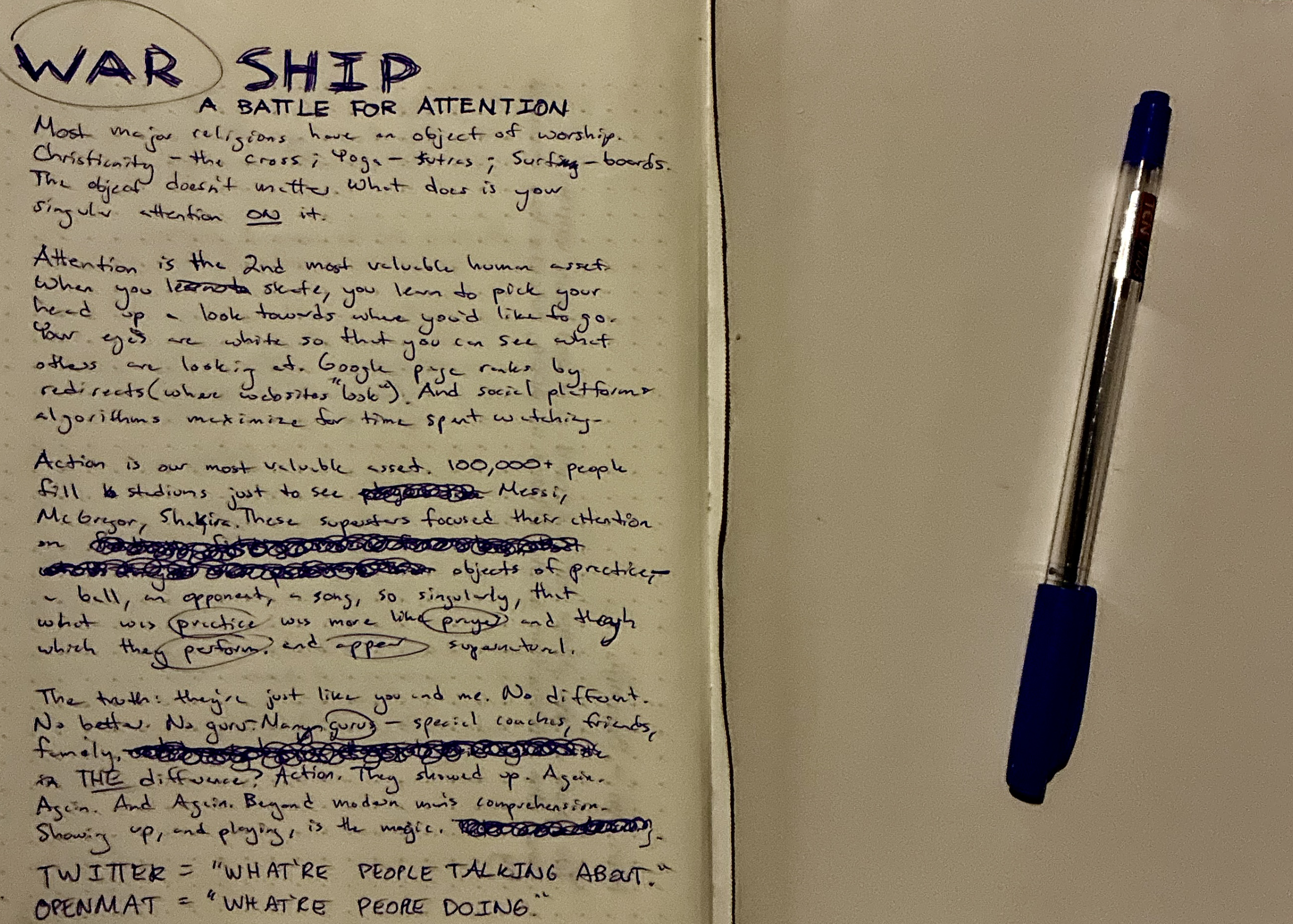
All religions have an object of worship. Something to fix your attention on. Whether it's a cross, some text, a surfboard, a dollar sign. The object isn't the point. Your attention is. But attention alone isn't what matters. Action is what matters. Action is the most valuable thing you own. Action is what belief is made of.
People fill stadiums to watch those who are so deeply practiced in their own religion--Messi, McGregor, Shakira--each focused their attention, then acted on it, again and again, until it became something that looks supernatural. It's not. It's attention turned into action over time.
I went to India looking for a teacher. What I found is that no one can replace that inner signal. You can learn from anyone--your mom, your friends, a yogi who's been in one place for 55 years--but no one can walk for you. The root of yoga is not in Bihar. It's not in a book. It's not in a guru. It's in the moment you stop ignoring yourself and start following what is actually true for you. I am who I am.